It is written for anyone who sits, leans in, and holds still for a living: tattoo and PMU artists, estheticians, barbers, dental and medical professionals.
What Precision Work Asks Of The Body
Most physical work involves movement. Lift, carry, walk, reset. Muscles contract, then rest, then contract again.
Precision work is the opposite. You lean in, you hold a position, and you stay there. The contraction never fully lets go. That kind of loading is called static posture, and it tires muscles in a different way than movement does. The muscles holding your trunk, shoulders, and neck in place are working the entire session, even though nothing looks like effort.
Then you do it again tomorrow.
That is the quiet math of this work. It is not one heavy lift. It is a low, constant load, held for hours, repeated for years.
The Chain Under A Steady Hand
Here is the part that changed how I think about seating.
Your hand does not stabilize itself. It borrows stability from everything under it. The seat supports the pelvis. The pelvis sets up the spine. The trunk holds the platform. The shoulders position the arm. The neck holds your eyes over the work. The hand is the last link in that chain.
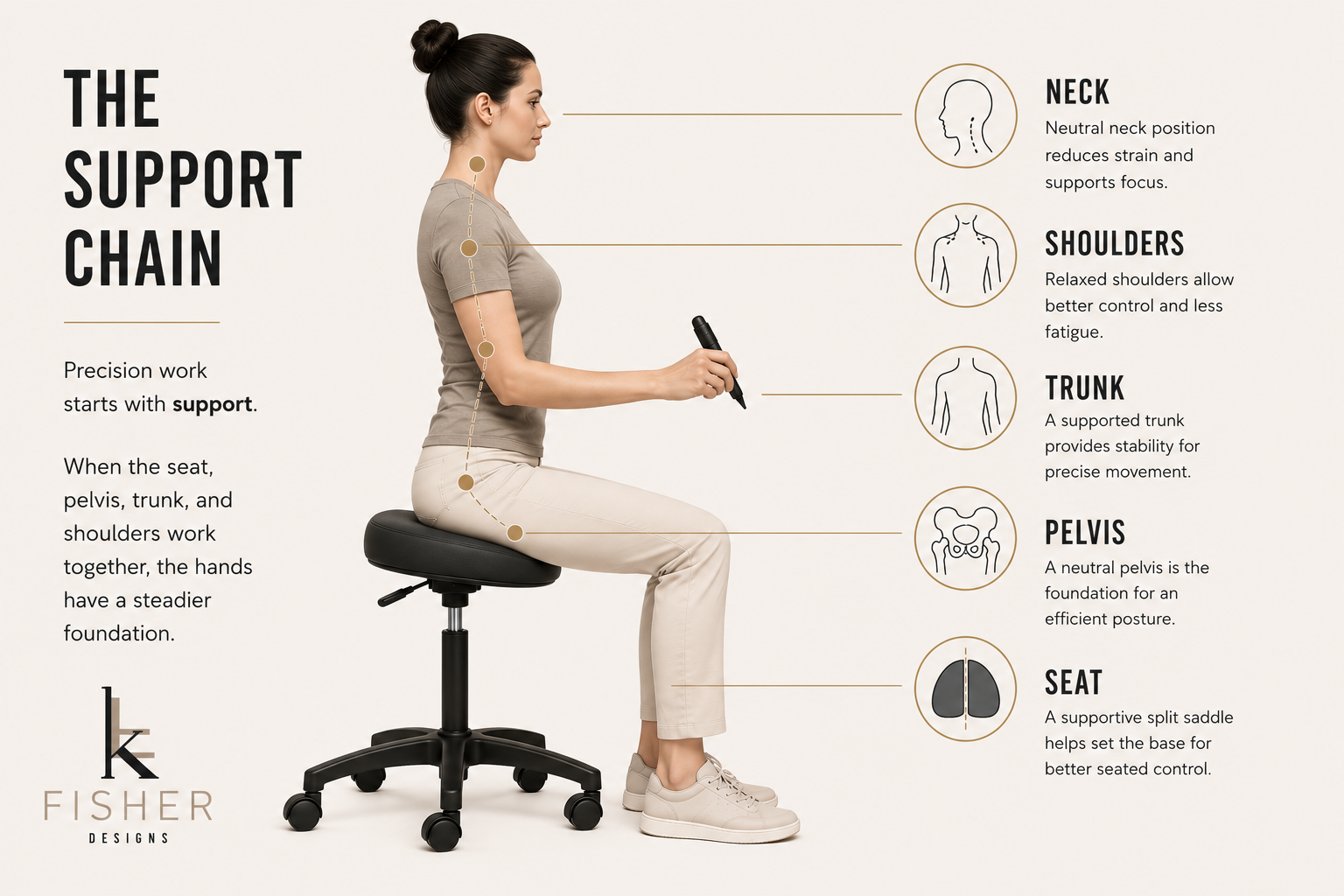
While the chain is fresh, the small muscles in your hand and forearm only have to do the fine work. As the session runs long and the support underneath starts to fade, posture begins to collapse forward, your reach gets longer, and those same small muscles have to work around the position of your body while they do the task.
That is why the end of a long day feels the way it does. It is not weakness. It is the chain wearing down from the bottom up.
What The Research Shows
There is not much research written for our professions, which is part of why I started collecting it. What exists points the same direction.
A study of practicing tattoo artists found that between 53 and 94 percent reported musculoskeletal discomfort over twelve months, depending on body region, and that roughly 71 percent of observed working postures scored in the high-risk range on a standard ergonomic assessment (Keester and Sommerich, 2017). The same paper notes there are no national ergonomic guidelines for tattoo work. Nobody wrote the manual for this job.
The neck deserves its own mention. Research on head position found that the effective load on the cervical spine rises steeply as the head tips forward: roughly 27 pounds at 15 degrees of flexion, climbing toward 60 pounds at 60 degrees (Hansraj, 2014). Precision work often pulls people toward that kind of forward-head posture. The farther your head drops to see the work, the more your neck has to carry.
And this is not just a tattoo problem. A 2022 study found that tattoo artists and dental workers show very similar pain patterns, both well beyond office workers (Weisman et al., 2022). Different rooms, different tools, same posture, same wear.
What Our Customer Discovery Shows
In June 2026 we ran a professional seating survey with 16 people across tattoo, PMU, barbering, esthetics, dental, and medical work. Small sample, still collecting, so treat these as early signal rather than proof. But the signal is loud.
88 percent reported at least one physical discomfort. The most common complaint was shoulder pain, at 63 percent. And 88 percent said their seating sometimes or often gets in the way of their work.
The written answers say it plainer than the numbers do:
“I have to reach further out to clients, which extends my back muscles.”
Tattoo artist, 10+ years
“The amount of leaning and moving around in the chair.”
Tattoo artist, 10+ years
Reach and leaning came up again and again. Not “my seat is uncomfortable.” More like: my setup makes me work farther from the work than I should, and my body covers the difference.
If you want the full breakdown of what we look for in seating because of this, it is in our free field guide, How to Choose a Stool for Precision Work.
What Actually Helps
None of this is a prescription. Bodies differ, rooms differ, and this is general ergonomic education, not medical advice.
A few things consistently make long sessions easier to manage, whatever stool you own today.
Get your height right, in the room you are actually in.
Height is a relationship between your seat, your elbows, and the work. If your shoulders are hiked or your head is dropped, the height is wrong for that station, even if it was right at the last one.
Keep the work close.
Reach is the silent load. The farther the work sits from your body, the more your back and shoulders spend to hold you there. Move the client, the bed, or yourself before you settle in.
Give the load somewhere to go.
Support belongs under your sit bones, with your hips able to open, so your trunk can stack instead of hang.
Break the hold.
Static posture needs interrupting. Stand between clients. Reset between stages. Short and regular beats long and rare.
Check your setup honestly.
Most of us inherited our seating and never questioned it. Run it through a real checklist once and see what it is actually doing to you.
Where The Stool Fits
I will keep this part short and honest.
K Fisher Designs is developing a portable ergonomic stool for seated precision work: a backless split-saddle seat, hands-free foot-actuated height adjustment, and a base that breaks down for travel. The design brief follows the chain described above: seat, pelvis, trunk, shoulders, neck, and hand.
It is in validation right now. It is not for sale, and I am not going to claim it reduces fatigue or steadies your hands, because that is exactly the kind of claim that needs evidence we are still gathering. What I can say is that the thinking in this article is the thinking behind the design, and we are building it with the professionals who will use it. For the saddle-seat research behind that direction, read Saddle Seating Evidence for Precision Work.
You can see where it stands on the stool page.
Keep Going
If this note was useful, four ways to go deeper:
Sources
- Keester, D.L. and Sommerich, C.M. (2017). Investigation of musculoskeletal discomfort, work postures, and muscle activation among practicing tattoo artists. Applied Ergonomics, 58, 137-143.
- Hansraj, K.K. (2014). Assessment of stresses in the cervical spine caused by posture and position of the head. Surgical Technology International, 25, 277-279.
- Weisman, A., et al. (2022). Tattoo artists and dental workers have similar musculoskeletal pain patterns. Occupational Medicine, 72(1), 43-50.
- K Fisher Designs Professional Seating Survey, June 2026, n=16. Survey open and ongoing.
This article is general ergonomic education. It is not medical advice, and nothing here is a claim that any product prevents or treats any condition.